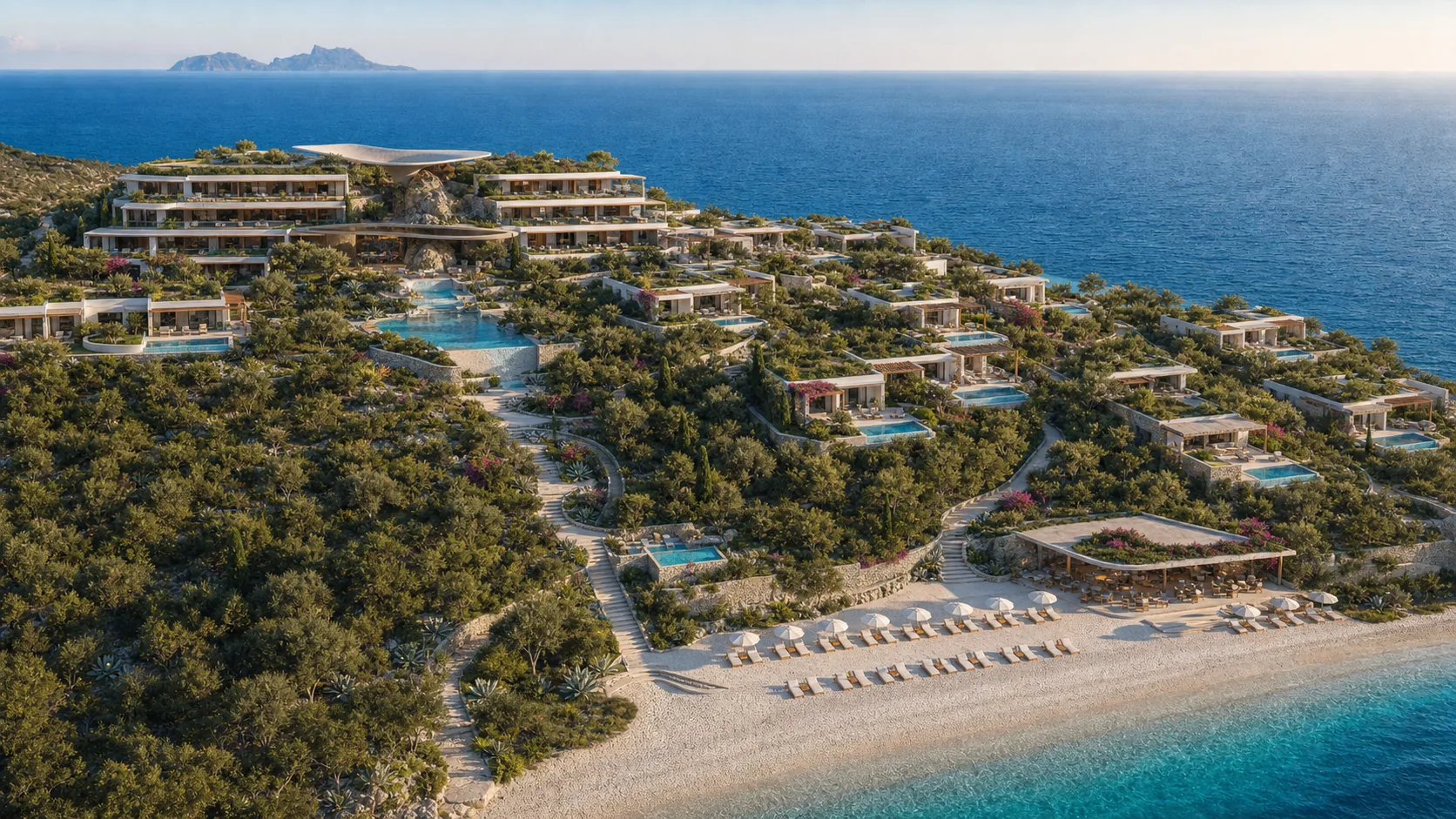
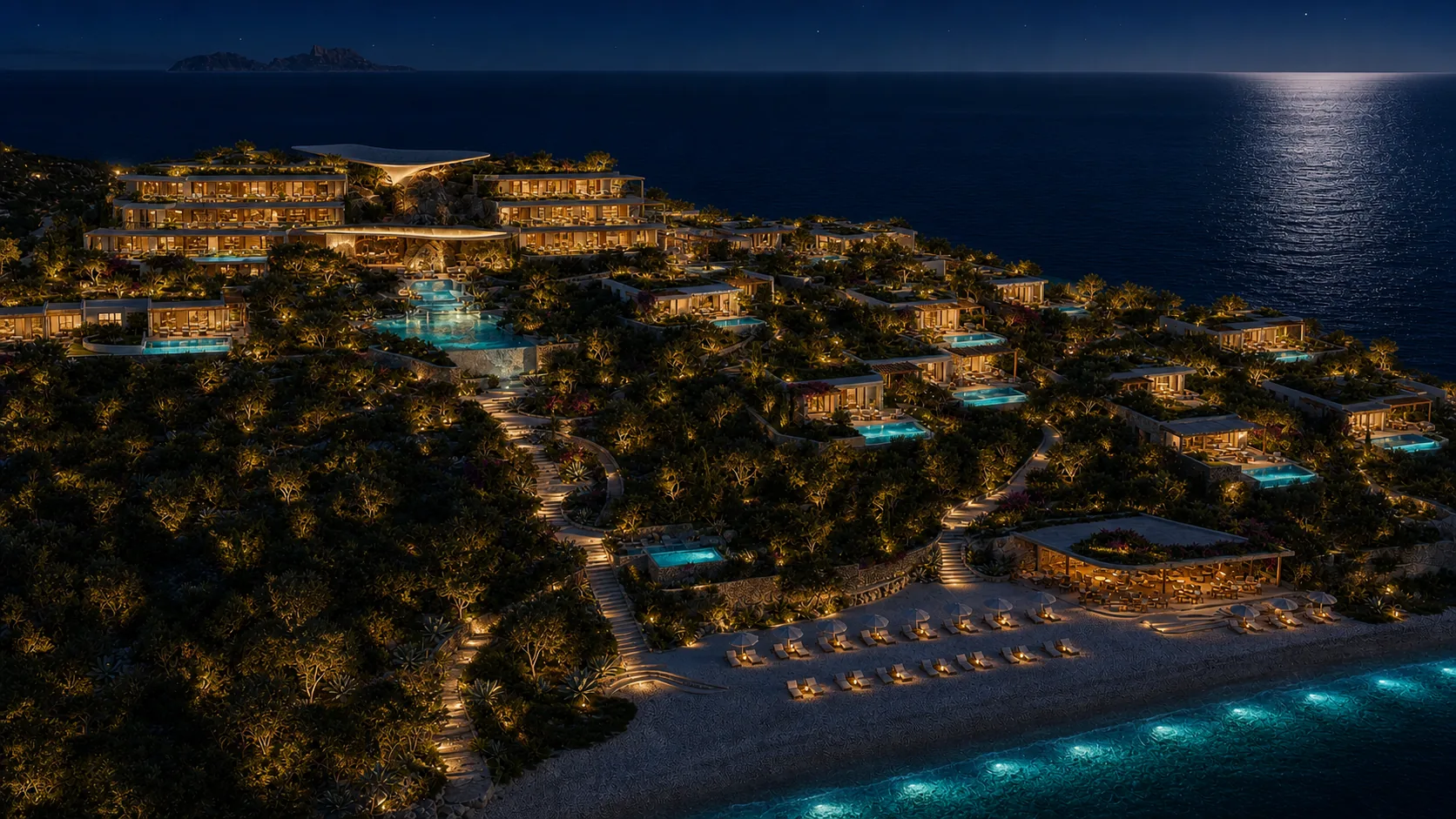
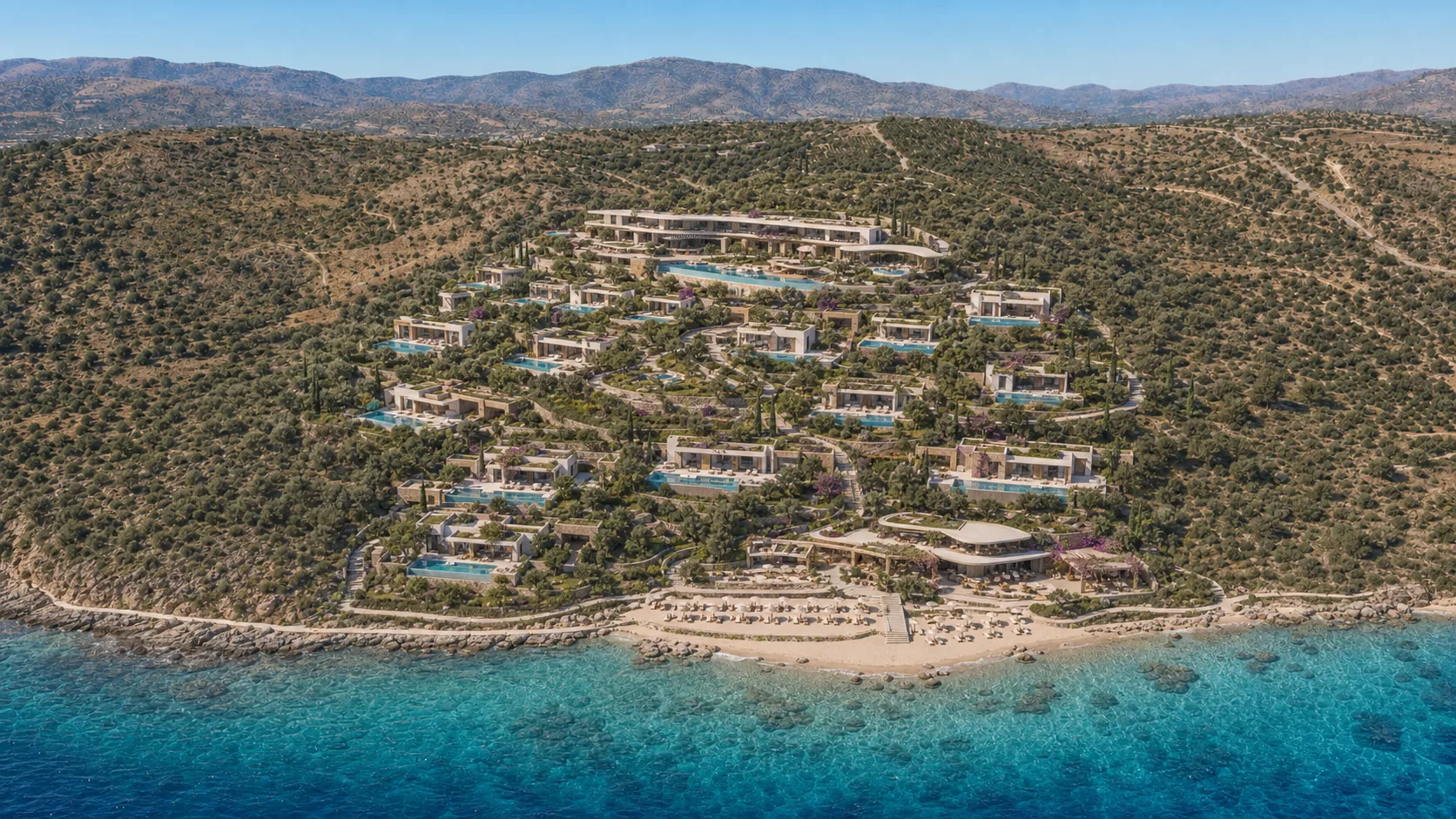
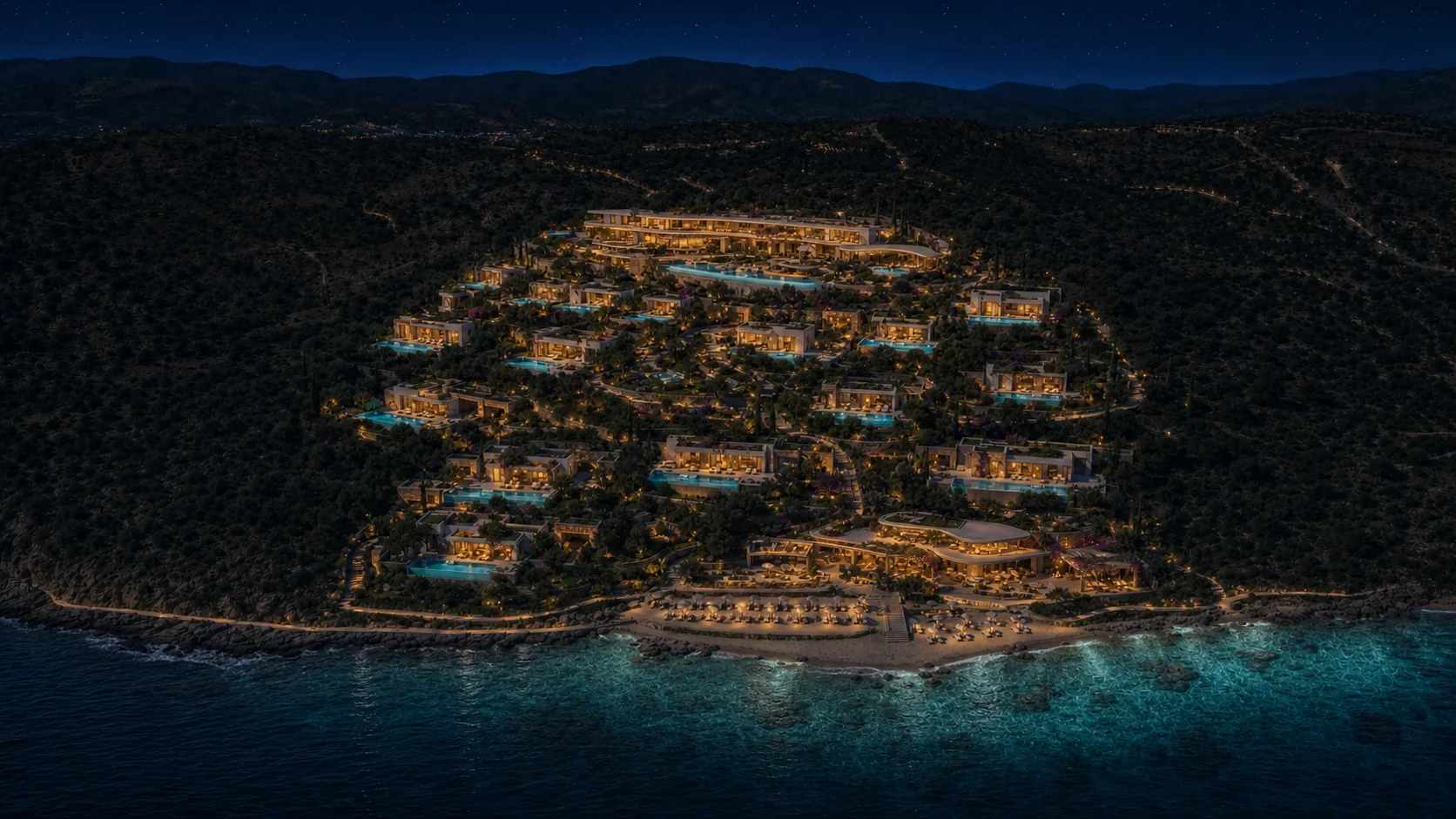
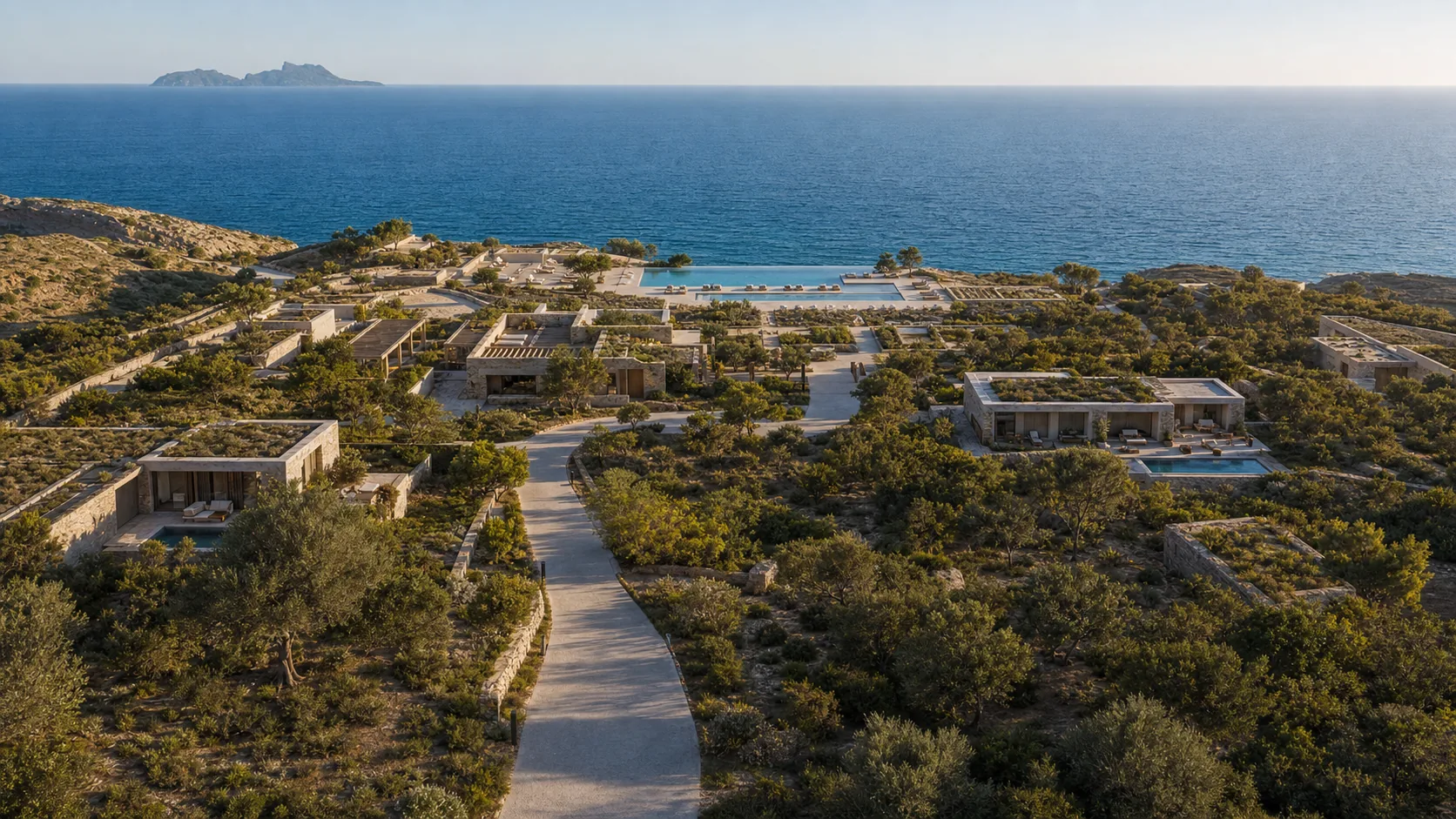
AI-generated concept — no such resort exists
South Crete · Libyan Sea

South Crete Beachfront Estate

Twelve hectares of private south-coast shoreline on Crete, with hotel use officially certified and the permitting groundwork already completed.

≈ 120,000 m²
Total site area
First line
Direct sea frontage
≈ 24,000 m²
Buildable above ground
€6,500,000
Guide price · negotiable

One of the last large coastal holdings on Crete with its legal work already done

The Cretan coastline has been sold off in fragments of 4,000–10,000 m² for two decades. Holdings at this scale — continuous shoreline, single family ownership, tourism use confirmed in writing — reach the market a handful of times a decade.

The estate is ≈ 120,000 m² of contiguous land inside a controlled tourism development zone under Crete's regional spatial plan, with an official certificate confirming that a hotel may be built on it. Access is via two separate roads, the property is free of loans and liens, and it can be transferred as an SPV.

This is not speculative land held for a future rezoning. It is a site an architect can start designing on now.

≈ 120,000 m²
Surveyed site area
0.2
Building coefficient (tourism)
2021
Hotel use certified
≈ €54/m²
Land cost, first line

Where it is

The south coast of Crete, facing the Libyan Sea. The exact position is released to qualified buyers under a confidentiality agreement.

Crete's south coast runs a season six to eight weeks longer than the north, at a fraction of the building density. There are no hotel walls here. There are open horizons, rock coves and water that looks retouched in photographs and looks the same in person.

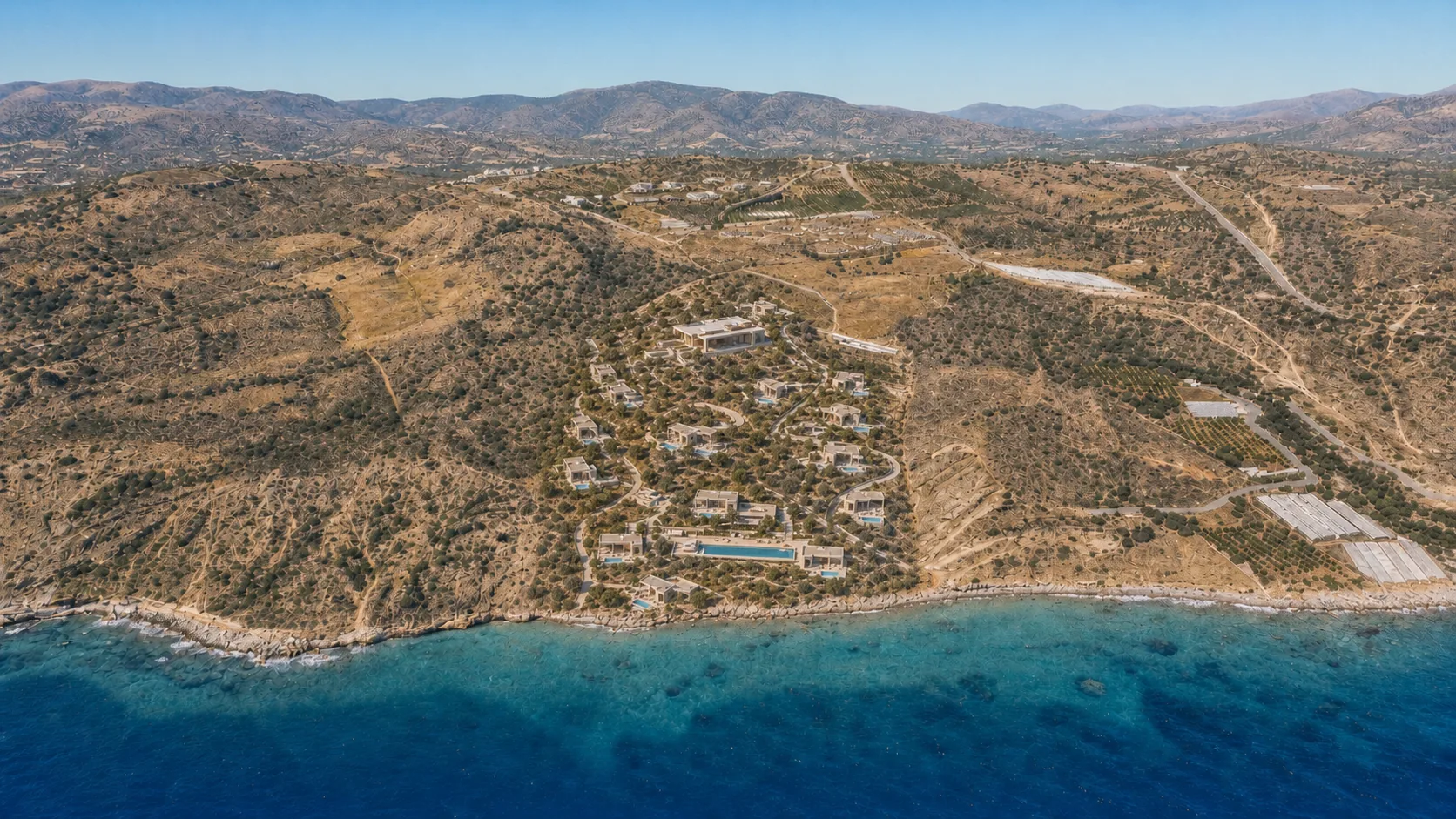
AI-assisted image The coastline seen obliquely from the sea, olive terraces rising to the mountains behind
The land as it is today. Oblique view generated from satellite terrain data — no buildings, no boundary overlay. Terrain, vegetation and neighbouring structures are approximations of the real landscape, not a survey.
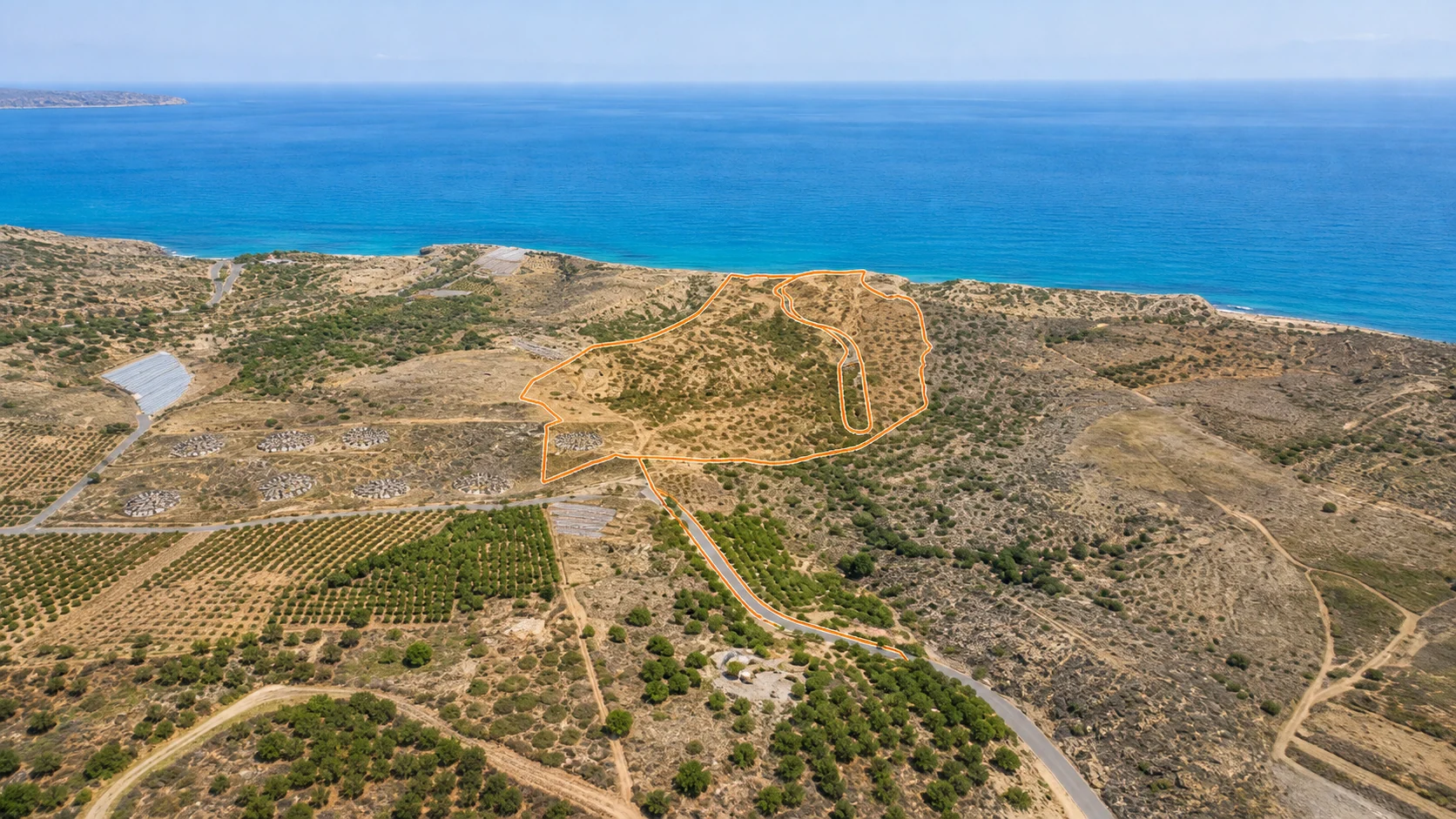
AI-assisted image Satellite view of the site with the boundary outlined in orange, running down to the shoreline
Site boundary, plan view. Satellite base imagery with an AI-assisted boundary overlay, drawn from the surveyed plan. Indicative only — the legally binding boundary is the 189-point topographic survey, available in the document pack.
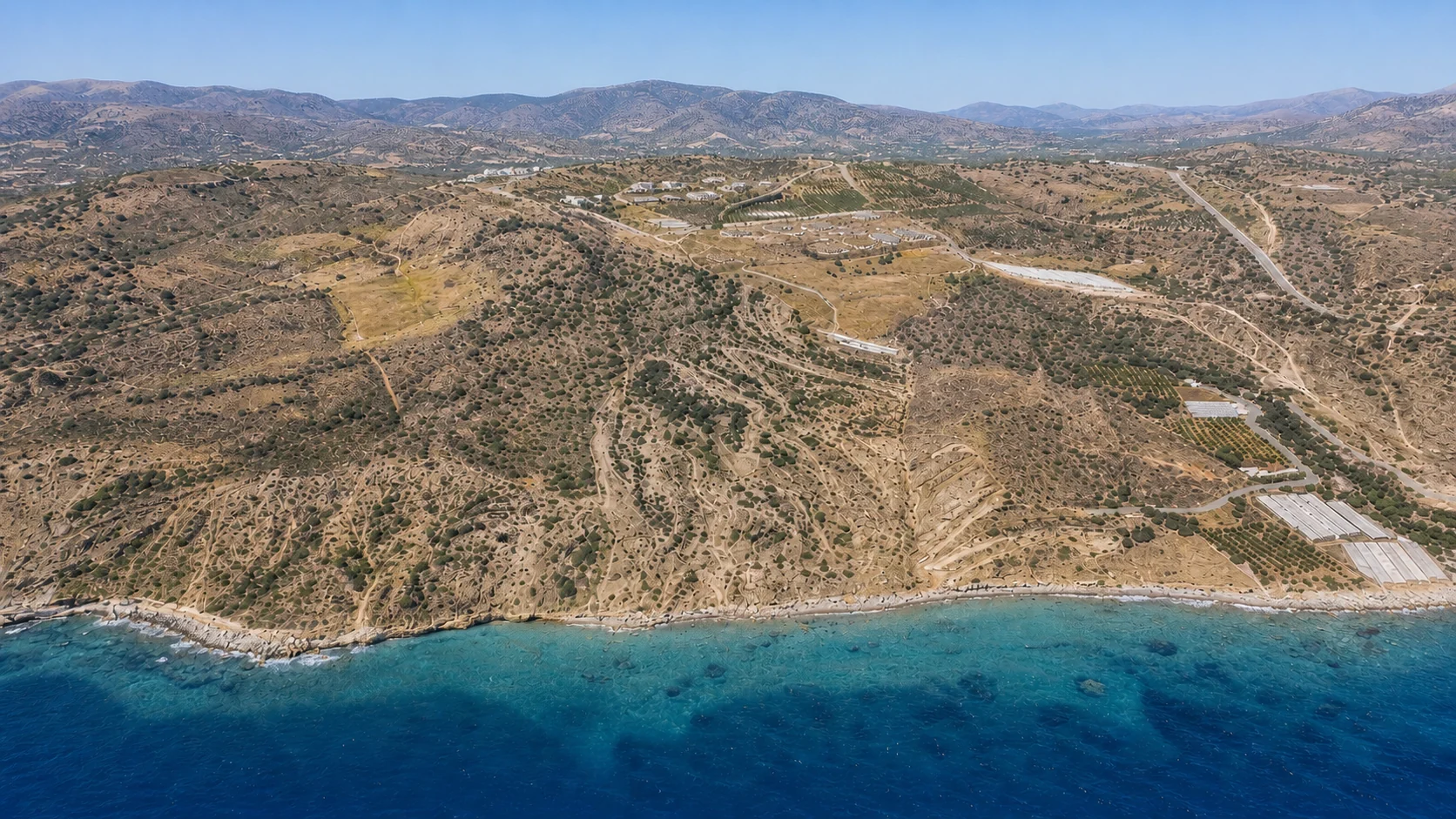
AI-assisted image Oblique aerial view of the site looking towards the Libyan Sea, boundary outlined in orange
Looking south to the Libyan Sea. The same boundary shown in perspective, with the two access roads visible below the site.

Getting there

  • Nearest harbour village (tavernas, services)≈ 10 min
  • Heraklion airport (HER)≈ 1 h 25
  • Chania airport (CHQ)≈ 1 h 50
  • Heraklion port≈ 1 h 20

Approximate driving times by road, for orientation. To be confirmed against the buyer's own routing.

Your guest arrives without changing planes.

Heraklion is Greece's second-busiest airport and connects directly to more than a hundred European cities — London, Paris, Munich, Vienna, Zurich, Tel Aviv among them — through a season that now runs from April into November.

From 2028 the traffic moves to the new Kastelli airport, with materially more capacity. See the market section below.

What is actually being sold

Two adjacent parcels in one family's ownership. Available as a whole or, subject to agreement, in parts.

Parcel 1Parcel 2Total
Surveyed area≈ 53,000 m²≈ 66,500 m²≈ 120,000 m²
ConditionUndeveloped, cleanOperating solar plant + reservoir—
Sea frontageDirectDirectContinuous
OwnershipSingle familySingle family100% freehold

The solar plant is an asset, not an encumbrance. Parcel 2 carries an operating photovoltaic installation and a water reservoir. For a developer that means connected grid capacity and a water point already on site — two line items that normally have to be created from zero in a remote coastal location.

Plant capacity, reservoir volume, and whether the power purchase agreement transfers with the land are confirmed in the document pack and should be reviewed at technical due diligence. On-site generation materially improves resort operating economics in a location with this much sun.

What can be built

The land sits outside the town plan (εκτός σχεδίου). For tourism use, a building coefficient of 0.2 applies, giving roughly 24,000 m² above ground across the holding, plus basement levels which do not count against the coefficient.

24,000 m²
Above-ground GFA
≈ 30,000 m²
Total constructed incl. basements
up to 300
Hotel keys at full density
up to 29
Villa plots, residential route
Planning parameterTourism useResidential use
Building coefficient0.20.18 (first 4,000 m²)
Minimum plot4,000 m²4,000 m²
Maximum height7.5 m7.5 m
Storeys22
Build per 4,000 m² plot—186 m²
Indicative total above ground≈ 24,000 m²≈ 5,400 m²

Parameters as recorded on the certified topographic plan and the 2021 land-use certificate, under Law 4759/2020 and the applicable tourism-facility provisions. Final figures are subject to confirmation by an appointed architect at design stage and may be affected by coastal setbacks, slope and access. Do not underwrite on these numbers without that confirmation.

Three ways to use the entitlement

The 0.2 coefficient can be spent in very different ways. Below are three, set out on the same assumptions and the same page so they can be compared directly. They are presented without preference — the right route depends on the buyer's appetite for operating risk, holding period and access to a hotel brand.

One fact shapes all three: the operating season on the south coast runs roughly April to October. Density has to be paid for over about 215 trading days a year, and every model here is built on that basis.

Route A

Full-density resort

Spend the whole entitlement. Around 300 keys across standard rooms, family suites and twenty beachfront villas, aimed at the mainstream 4★+/5★ market that fills Cretan resorts reliably. Operating business, institutional exit.

Built area used
24,000 m² · 100%
Total investment
≈ €106.6M
Stabilised NOI
≈ €9.4M
Yield on cost
≈ 8.8%
To first revenue
4–5 years
Route B

Boutique hotel + branded villas

A 70-key luxury boutique hotel plus 26 branded residences sold to private owners and placed in a rental pool. Uses about half the entitlement, leaving the balance as future phases. Requires a hotel brand.

Built area used
≈ 12,000 m² · 50%
Total investment
≈ €69.9M
Returned by villa sales
≈ €31.2M
Stabilised EBITDA
≈ €4.3M
Yield on net capital
≈ 11.1%
Route C

Residential subdivision

Split into up to 29 plots of 4,000 m² and build 186 m² sea-view villas for outright sale, in phases. No hotel, no operator, no operating business. Shortest route to cash, no recurring income.

Built area used
≈ 5,400 m² · 23%
Total investment
≈ €26.3M
Gross sales
≈ €34.8M
Gross margin
≈ 24% of sales
To first revenue
2–3 years

The figures on this page are an illustrative financial model built on mid-market benchmarks for Greek hospitality and residential development, 2024–2026. They are not investment advice, not an offer, and not a forecast or guarantee of return. Actual parameters follow from design, contractor tender and the operating agreement. They assume no debt: leverage, and the funding programmes described further down, change the equity return in every column.

The three routes, line by line

Route A — full densityRoute B — boutique + villasRoute C — subdivision
Programme
Above-ground GFA used24,000 m²≈ 12,000 m²5,394 m²
Total constructed area30,000 m²14,500 m²5,394 m²
Product≈ 300 keys70 keys + 26 villas29 villas
Capital cost
Construction€66.0M€42.1M€13.5M
FF&E€11.4M€3.9M—
Design, licensing, supervision€6.6M€4.2M€1.4M
Infrastructure, roads, landscape€7.0M€7.5M€3.2M
Contingency (10%)€9.1M€5.8M€1.8M
Land (guide price)€6.5M€6.5M€6.5M
Total project cost€106.6M€69.9M€26.3M
Less unit sales during build—−€31.2Mphased
Net capital at risk€106.6M€38.7M€26.3M
Trading, stabilised
Operating season215 days215 daysn/a
Occupancy on operating days70%70%n/a
ADR€400 blended€680n/a
Rooms revenue€18.1M€7.2Mn/a
Ancillary revenue€15.4M€4.3Mn/a
Total revenue€33.4M€11.5M€34.8M (sales)
Operating margin28% NOI34% EBITDAn/a
Stabilised NOI / EBITDA€9.4M€4.3M—
Return
Yield on net capital8.8%11.1%n/a
Gross development margin——€8.5M · 24% of sales
Exit value at 13× / 14× earnings≈ €121.6M≈ €60.2Mn/a — sold unit by unit
Time to first revenue4–5 years3–4 years2–3 years
Operating business requiredYesYesNo
Hotel brand requiredPreferableYesNo

Sensitivity — what moves each route

RoutePrincipal driverDownsideBaseUpside
A · full densityADR and occupancy€340 @ 62%€400 @ 70%€470 @ 76%
Stabilised NOI€7.0M€9.4M€11.9M
Yield on €106.6M6.6%8.8%11.2%
B · boutique + villasVilla price and ADR€5,000/m² · €560 @ 60%€6,000/m² · €680 @ 70%€7,200/m² · €820 @ 78%
Net capital at risk€43.9M€38.7M€32.5M
Stabilised EBITDA€2.4M€4.3M€6.4M
Yield on net capital5.4%11.1%19.6%
C · subdivisionVilla sale prices, ±15%€29.5M sales€34.8M sales€40.0M sales
Gross margin€3.2M · 11%€8.5M · 24%€13.7M · 34%

How to read these. Route A is a volume play: the return is driven by rate and occupancy across a large key count, and it is the least sensitive to any single assumption but the most exposed to construction cost. Route B has the highest headline yield because roughly 45% of project cost is recovered through residence sales before opening — but that recovery depends on pricing above roughly €5,500/m², which in practice depends on signing an international operator before construction. Route C carries no operating risk and turns cash fastest, at the cost of any recurring income or exit re-rating.

Where the money is made in Routes A and B. Greek hotel assets are valued as businesses — as a multiple of earnings, not as a price per square metre. Land is bought at land prices; a completed, trading resort is sold to an institutional buyer at 12–16× EBITDA. That re-rating, not the rental stream, is the bulk of the developer's return. Expect three to five years from purchase to opening and a further two to stabilisation. Route C has no equivalent — the margin is taken unit by unit as each villa completes.

A note on method. Resort models for Greek sites are routinely built on a 365-day trading year. On the south coast that overstates revenue badly: to reach 65% occupancy across a full calendar year, a property with an April-to-October season would have to run at well over 100% every night it was open. Every figure on this page is built on a 215-day operating year instead. That is why the yields shown here are lower than some quoted for comparable Cretan sites — and why they are the ones likely to survive a lender's underwriting. They remain illustrative, and should be re-underwritten by the buyer against real comparable properties on the south and west coasts before any commitment.

Why Crete, why the south, why now

Three things are converging on this coastline at the same time: record and still-rising traffic, a step change in airport capacity from 2028, and the first wave of institutional capital committing to the south coast specifically.

10M+
HER passengers, 2025
9.38M
HER passengers, 2024
2028
Kastelli airport opens
18M
Kastelli maximum capacity

Traffic at record levels, still climbing

Heraklion handled 9.38 million passengers in 2024 and passed 10 million for the first time in 2025 — comfortably above its pre-pandemic peak, and the busiest island gateway in Greece. Chania adds roughly 4 million more. The season keeps extending at both ends: April and October have moved from shoulder months to full trading months, which is exactly what a capital-intensive resort needs.

Kastelli: a new airport in 2028

Crete's new international airport at Kastelli, roughly €1 billion of investment, is targeting a November 2028 opening. It is built to handle around 11.5 million passengers in its first year and up to 18 million at full build-out, replacing an airport that is already at its ceiling. A resort opening in 2029–2030 opens into that capacity, not against today's constraint.

Institutional capital has reached the south coast

The benchmark scheme is PHĀEA – South Crete by the Sbokou and Vassilakis families, at Skouros in the municipality of Viannos, south Heraklion: a €121.11 million sustainable 5★ resort of 140 rooms and 30 villas on a 155,000 m² site, with spa, organic gardens and restaurants, creating some 83 permanent jobs. It has been granted Strategic Investment status and approved for state incentives, and it sits 38 km from the new Kastelli airport.

And across the rest of the island

Crete is in its largest wave of hotel investment on record — though almost all of it on the north, east and west coasts: Elounda Hills near Agios Nikolaos, €400 million over three phases and roughly ten years; Cretan Tale at Mylopotamos, a €235.8 million resort-and-marina scheme; Cape Tholos at Kavousi in the Mirabello gulf, €126 million for 189 rooms, 136 residences, spa, marina and helipad; and Ikos Kissamos in the west, at an estimated €125–150 million the largest single hotel investment in Cretan history, opening April 2026.

What that means for this site

PHĀEA is the closest read-across there is: a comparable site on the same coast, absorbing €121 million of capital for 140 keys plus residences — and clearing the Strategic Investments process to do it. It sets the benchmark for what serious money now pays to be on the south coast, and it proves the incentive route is open. It is also, so far, close to the only one. This estate is ≈ 120,000 m² with hotel use already certified, at a land cost of roughly €54 per m².

The south has almost no luxury supply

The existing 5★ stock is concentrated on the north coast — Elounda, Agios Nikolaos, Rethymno. The south coast has a comparable and longer season with virtually no modern luxury product. Guests who want that coastline currently have nowhere to stay.

Land at this scale is finished

Contiguous coastal holdings of this size, in single ownership, with tourism use confirmed, are effectively exhausted on Crete. Each successive transaction has cleared at a higher price than the last. Greece also offers residency by investment, a favourable regime for new tax residents, and the incentive programmes described above — all of which change repeatedly and require current Greek legal and tax advice.

Passenger figures from Heraklion Airport and Greek civil aviation reporting; airport and project figures from public announcements as at mid-2026. Timelines for major infrastructure and third-party schemes routinely move — verify before relying on any of them.
How the transaction runs

  1. First contact and NDA

    We release the full pack: topographic plan, land-use certificate, forest map extract, watercourse decision, titles, solar plant documentation.

    3–5 days
  2. Legal due diligence

    An independent Greek lawyer checks titles at the cadastre and the mortgage registry. We can recommend specialists; we do not impose them.

    2–4 weeks
  3. Preliminary contract and deposit

    Typically 10%, in notarial form.

    1 week
  4. Technical due diligence and funding review

    An architect confirms the buildable envelope and an engineer the utilities. First concept sketches run in parallel, and this is the point at which the financing adviser assesses the funding stack.

    3–6 weeks
  5. Final deed and registration

    Signature before the notary and transfer of title — or transfer of the SPV holding the land, if that structure is preferred.

    2–3 weeks

Three to four months is typical from first contact to registration. We run the whole transaction: lawyer, notary, translator, Greek bank account and the AFM tax number a foreign buyer needs.

€6,500,000
Guide price · negotiable · ≈ €54 per m² · first line

Request the document pack

The full set — topographic plan, land-use certificate, forest map extract, watercourse decision and title documents — is released on request under a confidentiality agreement. Introductions to the financing adviser are arranged on the same request.

AD
Anna Danilova
Founder · Orea Estate · Crete, Greece